Topic vs. Title
Quite similar in wording, these two terms are often confused when starting out with scientific work. To enable a clear differentiation without overlapping, let's clarify some things here:
The Topic
When starting any kind of written work, what most authors initially think about is the general outline of what they want to produce. This usually provides some context on the what, how and why of the text to be written, indicating its cornerstones that the rest is built upon. When thinking about The Lord of the Rings, for example, a basic setting (aka topical context) is as follows:
- An evil ring crafted by an evil master
- Two unsuspecting, innocent characters
- A dangerous, bloody quest of destroying said evil ring
- The friends they make along the way
- Impending doom in case of failure to complete that dangerous quest
This defines the what of the story - describing its protagonists, antagonists and goal. The how in this case is the way the two hobbits must take to destroy the ring, whereas the why is quite obviously the aversion of that impending doom (to be more specific: the destruction of the whole world).
When applying this to non-fictional works such as scientific papers or theses, we would also call this general overview the topic of the work to be written, including all the aspects that we want to talk about:
- Contextual setting
- Background and motivation
- Existing research
- Open questions
- Contribution of the work
The Title
Where the topic can get quite exhaustive (but shouldn't), the tile should be rather comprehensible. The title of any scientific work should be able to convey the key content and provide prospective readers with a glimpse of what it is about - just don't make it too long or too mysterious (do not call your paper The Lord of the Something). What commonly happens to aspiring researchers is that they tend to overthink their title whilst forgetting about the importance of the topic that supports the title - try to not get sidetracked by the sheer focus on finding a catchy title, but instead work with what you got and try to keep it simple.
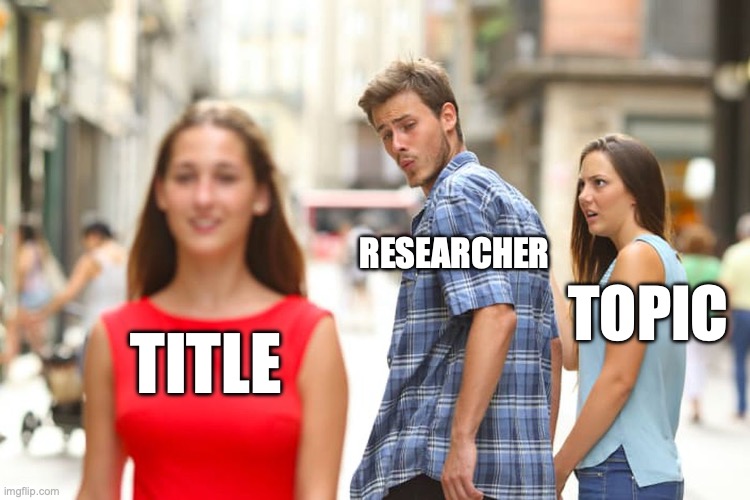
A good title should not take more than two lines - which is often not the case, as you will find out when we talk about references - but for now, try to keep it rather that way. Additionally, think about the following title:
A Game of Thrones
Does this create interest in you? Does it even make you excited? For scientific titles, we also aim at creating titles that catch the reader's eye - just not in the same way as with fantasy books. Your title should, nevertheless, draw attention of the prospective reader - after all, you also want them to be excited about the problem that you solve! Let's take the following fictious title as an example:
A Study of Bacterial Growth in Controlled Environments
Does this create excitement? Maybe it does, in case you are a biologist - but still, this title misses key information. It does not elaborate on which controlled environments or bacteria it talks about, it also does not mention what kind of study or methodology is used here. It is therefore of crucial importance to include such necessary information in a title - opposed to what we see in fiction and fantasy, where the deliberately ommiting information adds additional suspense (we don't do that here).
Here is a checklist to figure out whether your title is short enough, catchy, and conveys all the necessary information.